

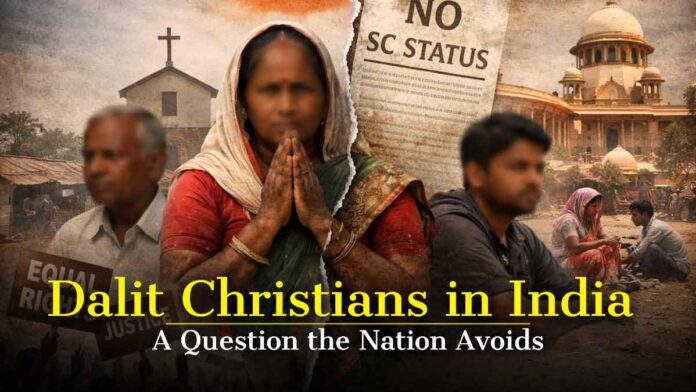
In India, we pride ourselves on being the world’s largest democracy. But beneath that claim lies a question few are willing to confront. Can a citizen be forced to choose between faith and fundamental rights? For Dalit Christians, this is not a theoretical debate—it is a lived reality.
Caste, we are told, is permanent by birth. It does not disappear through education, marriage, or social mobility. And yet, the moment a Dalit embraces Christianity, the State redraws that identity. The Supreme Court of India has upheld that such individuals are no longer eligible for reservation benefits.
So what exactly changes?
Their faith—or our definition of justice?
This is the contradiction at the heart of modern India. A system that acknowledges historical discrimination, yet withdraws protection the moment belief changes. The discrimination does not vanish—but the support does.
Is this policy—or is this selective blindness?
Dalit Christians today exist in a fractured space: socially vulnerable, politically underrepresented, and legally constrained. The system neither fully includes them nor honestly addresses their marginalization.
And yet, the silence around this issue is deafening.
Where is the political will?
Where is the moral urgency?
Who speaks when justice becomes conditional?
But the questions do not stop with the State.
They extend—uncomfortably—to within the community itself.
For years, sections of influential Christian leadership have grown in power, wealth, and visibility. Mega platforms, global networks, financial strength—these are no longer rare. But in moments like this, one question demands to be asked:
Has influence translated into impact?
If faith in Jesus Christ stands for justice, compassion, and standing with the marginalized, then where is that reflection today?
Because silence is not neutrality.
Silence is a position.
When systems exclude, and leadership stays quiet, the burden shifts back to the most vulnerable.
This is where the real challenge emerges.
Dalit communities themselves must confront an uncomfortable truth: waiting for change is no longer an option. Representation that is symbolic, fragmented, or self-serving will not alter realities.
The time for passive leadership is over.
Educated, ethical, and fearless voices must step into public life—especially politics. Not as tokens, but as decision-makers. Not as participants, but as disruptors.
Because systems do not change out of goodwill.
They change under pressure.
At the same time, those who hold influence—social, religious, or economic—must decide what they stand for.
Is leadership about visibility—or responsibility?
Is faith about identity—or action?
Is success personal—or collective?
This moment is not just another policy debate.
It is a test of integrity—for institutions, for leadership, and for society itself.
• Will we continue to ignore uncomfortable truths?
• Will faith remain private while injustice remains public?
• Will leadership choose comfort over courage?
If Dalit Christians continue to be pushed into this contradiction, the cost will not just be theirs—it will be borne by the credibility of justice itself in India.
Because a democracy that conditions rights on belief is not resolving inequality—it is reshaping it.
And the question will not disappear.
It will only grow louder.
How long can a nation ask its people to choose between who they are and what they believe?
⚖️📜 #SupremeCourt rules #SC/STAct applies only to Scheduled Castes and Tribes who have not converted 📜⚖️ https://t.co/k7pDUn8Oem pic.twitter.com/d4m55SMdzP
— Economic Times (@EconomicTimes) March 25, 2026
BREAKING | Conversion to any other religion apart from Hinduism, Sikhism, or Buddhism results in loss of scheduled caste status: Supreme Court pic.twitter.com/MfqBAhzZnF
— Bar and Bench (@barandbench) March 24, 2026
ALSO READ: Breaking Boundaries: Indian Women’s Cricket Social Change