

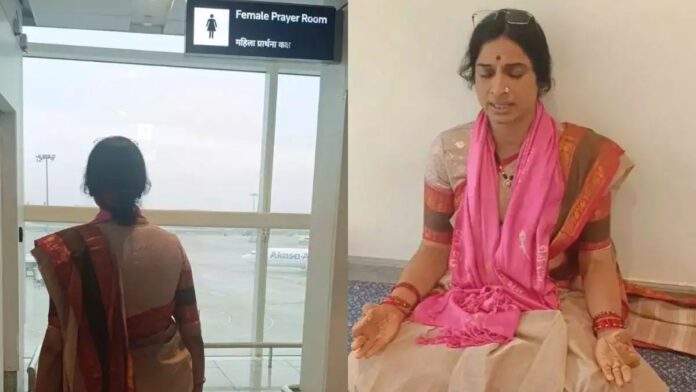
In India’s fast-evolving political landscape, a disturbing shift is becoming impossible to ignore—politics driven by provocation rather than purpose. The recent controversy involving Madhavi Latha is not just another viral moment. It is a reflection of a deeper problem.
A video recorded inside a multi-faith prayer room at Delhi’s airport shows her chanting while deliberately framing burqa-clad women in the background. This was not a private act of devotion. It was recorded, positioned, and shared.
This was not faith. This was messaging.
And more importantly—it was calculated.
Because this is not an isolated incident. From making provocative gestures near a mosque, to questioning burqa-clad women at polling booths, to now turning a prayer space into a political stage—there is a visible pattern.
Create tension. Capture attention. Stay relevant.
In today’s attention-driven politics, controversy has become currency. The louder the act, the wider the reach. But while visibility rises, the purpose of leadership quietly erodes.
India is not short of real issues—unemployment, education gaps, social inequality. Yet, instead of solutions, we are increasingly witnessing spectacle.
And that raises a serious concern:
Are politicians solving problems—or manufacturing them? Madhavi Latha Controversy
Public figures are not ordinary individuals. Their actions influence society. When faith is used as a visual tool to provoke, it does not strengthen democracy—it weakens it.
Because once provocation is rewarded, it stops being an exception.
It becomes a strategy.
This is not about religion.
This is about responsibility.
Faith, when genuine, does not seek validation through a camera. Leadership, when sincere, does not rely on controversy for relevance.
The real danger lies beyond one individual.
It lies in normalization.
If such actions continue to gain traction, we risk creating a political culture where substance becomes secondary and spectacle becomes standard.
And that is not just a political failure—it is a societal one.
The question India must now ask is simple:
Do we want leaders who serve—or leaders who perform?
Because a democracy cannot survive on attention alone.
It needs accountability, integrity, and intent.
India deserves leadership—not provocation.