

After PM Modi’s Ladakh visit, China says avoid actions that escalate tensions

Date:

Share post:

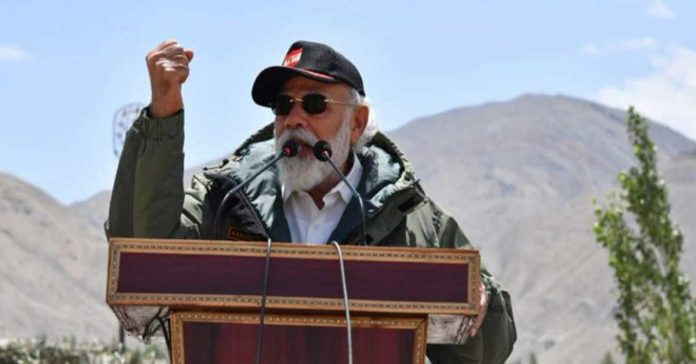
Prime Minister Narendra Modi on Friday visited Leh where he interacted with personnel of the Army, Air Force and ITBP, days after a violent face-off between Indian and Chinese troops in East Ladakh.

Hours after Prime Minister Narendra Modi arrived in Ladakh on Friday, China said negotiations are on with India to “lower the temperatures”, while adding that no party should engage in any actions that could escalate the situation.

China said negotiations and communications on “lowering the temperature” are on, while adding that no party should engage in actions that may escalate the situation. These comments from the Chinese Foreign Ministry came after PM Modi arrived in Ladakh on Friday.

“India and China are in communication and negotiations on lowering the temperatures through military & diplomatic channels. No party should engage in any action that may escalate the situation at this point,” Zhao Lijian, Chinese Foreign Ministry spokesperson on PM Modi’s Ladakh visit.

PM Modi, accompanied by Chief of Defence Staff Gen Bipin Rawat, reached Leh around 9.30 am. The PM was also briefed by senior Army officers.

The Prime Minister also interacted with personnel of the Army, Air Force and Indo-Tibetan Border Police (ITBP) at Nimoo.

Located at 11,000 feet, Nimoo is among the toughest terrains, on the banks of river Indus and surrounded by the Zanskar range.

ALSO READ: PM Modi on Ladakh front with strong message to protect border from China’s PLA

LEAVE A REPLY

Please enter your comment!
Please enter your name here

Newsletter Signup

digital marketing & AI training ad

Related articles from Tags

Dalit Christians in India: A Question the Nation Avoids

In India, we pride ourselves on being the world’s largest democracy. But beneath that claim lies a...

Madhavi Latha Controversy: Provocation Replaces Public Service in India

In India’s fast-evolving political landscape, a disturbing shift is becoming impossible to ignore—politics driven by provocation rather...

Union Budget 2026‑27: What It Means for the Common Man

The Union Budget 2026‑27 arrives with one big promise: growth that actually touches ordinary lives. Framed around “Yuva...

After 2025: Why NRIs and H‑1B Visa Holders Remain on Edge

The calendar has flipped to 2026, but for millions of NRIs and H‑1B visa holders, the shockwaves...

Breaking Boundaries: Indian Women’s Cricket Social Change

Indian women’s cricket is changing the game—and our society. As an educator, I see the ripple effects...

Janaki vs CBFC: A Name, a Narrative, and the Battle for Creative Freedom

Amid rising conversations around censorship and artistic liberty, the recent controversy surrounding the upcoming Malayalam courtroom drama...

Emotional Marketing: The Weapon of Choice for India’s Right-Wing Politics

In an era where public opinion is shaped less by facts and more by feelings, emotional marketing...

Pakistan used Turkish Asisguard Songar Drones targeting Indian military bases

In the latest escalation along the Line of Control and beyond, Pakistan has reportedly deployed Turkish-made Asisguard...

26/11 Mumbai Attacks: Key Accused Tahawwur Rana Extradited to India

In a significant development in the 26/11 Mumbai terror attacks case, Tahawwur Hussain Rana, a key accused...

Machines That Think: Are We Ready for the Age of AGI?

In the rapidly evolving realm of technology, Artificial General Intelligence (AGI) stands as both a beacon of...

From WhatsApp to YouTube: How Fake News Spreads Like Wildfire in India

In a country of over 1.4 billion people, information travels faster than light but so does misinformation....

Myanmar’s Earthquake Tragedy Unfolds – Devastation and Resilience

In the early hours of March 28, 2025, a powerful 7.7-magnitude earthquake struck Myanmar’s central region, sending...